Critical asset monitoring with GSM intrusion alerts
The Connix Asset Monitor turns any security sensor into an SMS and voice-call alarm with a local hooter, for unattended, high-value sites.
Overview
Unattended assets such as telecom shelters, pump houses, solar plants, substations, warehouses, ATMs, DG sets, construction sites and remote machinery are frequent targets of theft and burglary. Losses are rarely limited to the stolen item: downtime, replacement lead time and compromised operations often cost far more.
The Connix Asset Monitor is a compact GSM unit that connects to any security sensor, raises a local alarm through its relay outputs and immediately notifies the owner by SMS and voice call. The owner can also switch the outputs on or off from anywhere by sending an SMS. No internet connection, local network or cloud subscription is needed.
The challenge
- Delayed response. Remote and unmanned sites have no one present to see or respond to an intrusion.
- Connectivity gaps. Wired alarm panels and IP cameras depend on local networks or internet, which are often missing or unreliable at remote sites.
- Local-only alarms. Conventional alarms sound locally but do not tell the owner, so the intruder leaves with the asset.
- Harsh conditions. Dust, heat, moisture, vibration and unstable power supplies disable ordinary electronics.
- Sensor lock-in. Most security systems are built around one sensor type and cannot take what the site already has.
The solution
The unit sits between the sensors installed at the site and the people responsible for it. When a connected sensor triggers, the unit activates its relay outputs to drive a hooter, buzzer or flash light, and sends alerts to the designated mobile numbers by SMS and voice call. Registered numbers can then send an SMS to operate the outputs remotely.
Key features
| Feature | Description |
|---|---|
| GSM connectivity | 4G with automatic 2G fallback, so alerts still go out where only 2G coverage is available. |
| 2 digital inputs | Accept the trigger output of any security sensor: camera, motion sensor, door sensor or any other device that gives a trigger output on a theft or burglary event. |
| 2 relay outputs | Switch a hooter, buzzer, flash light or any other deterrent device to scare off the intruder. |
| Alarm and alerts | Captures activity through the connected sensors, generates an alarm and sends alerts by SMS and voice call to designated numbers. |
| SMS control | Registered numbers can control the relay outputs by sending an SMS, from anywhere in network coverage. |
| Wide power input | Operates on 5 – 24 V DC, so it can run from a battery, solar system, vehicle supply or standard DC adapter. |
| Rugged enclosure | Easy to install and built to work in harsh environments. |
System block diagram
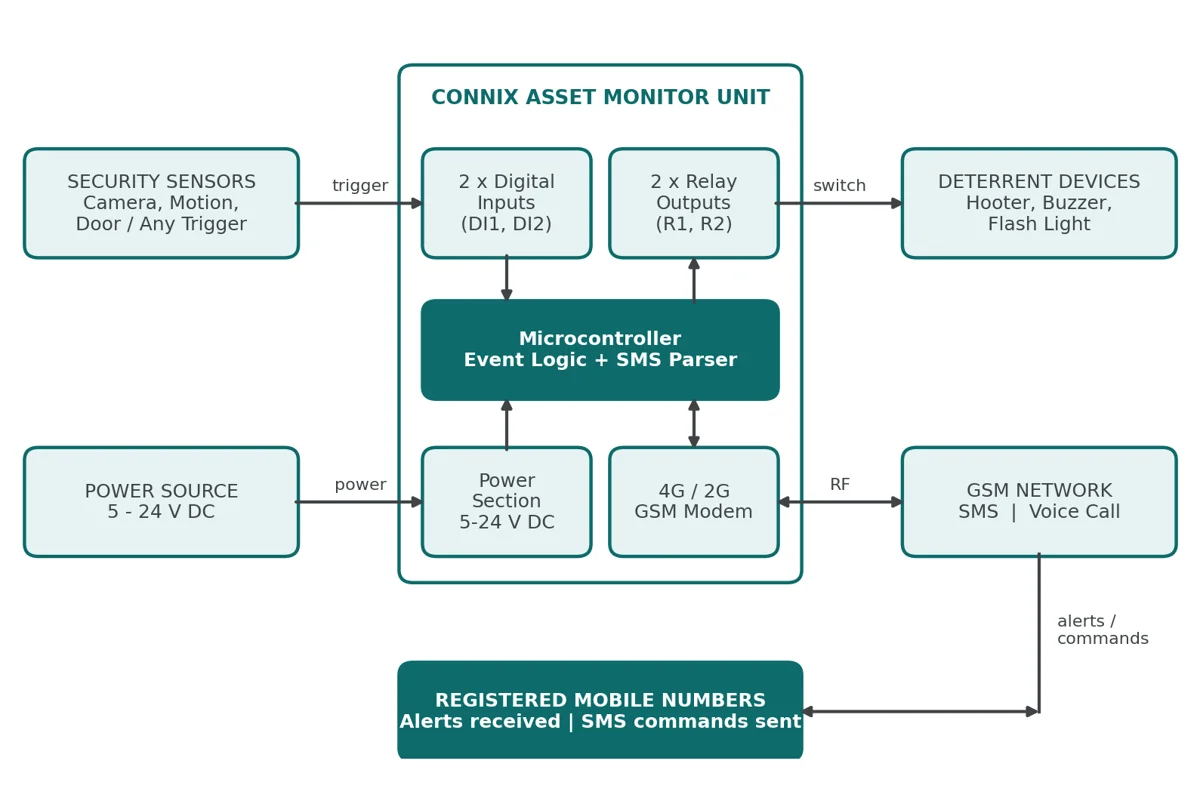
Figure 1 shows how the unit connects the site's sensors and deterrent devices to the GSM network and the registered mobile numbers.
Operating flow
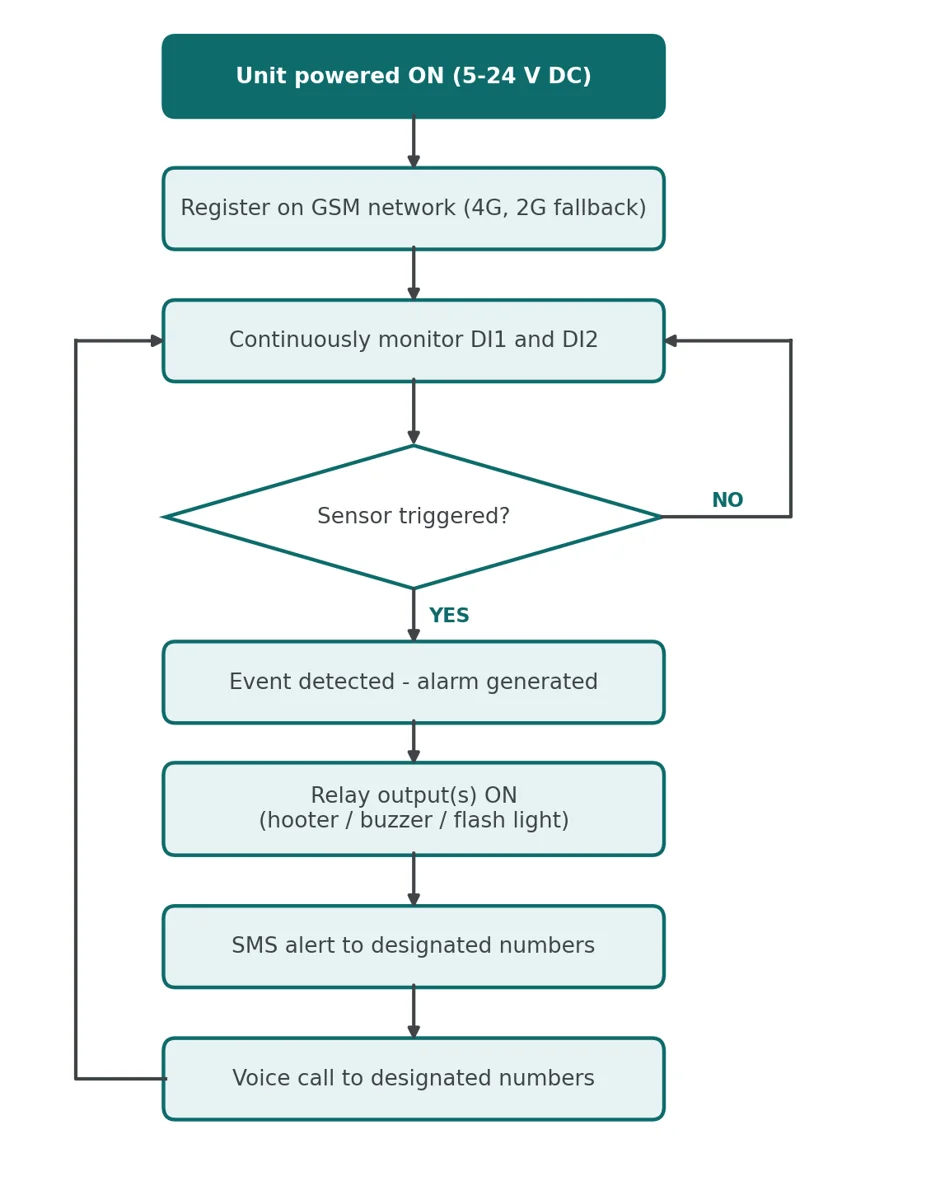
Figure 2 shows how the unit behaves from power-up through detection, alarm and alerting. SMS commands from registered numbers are accepted at any time, independent of this cycle.
How it works
- Start-up. On power-up the unit registers on the GSM network over 4G, falling back to 2G if 4G is unavailable.
- Monitoring. DI1 and DI2 are continuously monitored for a trigger from the connected sensors.
- Detection. When a sensor triggers, the unit treats it as an event and generates an alarm.
- Local deterrence. Relay outputs R1 and R2 are switched to operate the hooter, buzzer, flash light or other connected device.
- Remote alerting. SMS alerts and voice calls are sent to the designated numbers.
- Remote control. A registered number can send an SMS to switch the outputs on or off, for example to silence the hooter after the site has been checked or to trigger it remotely.
Only registered numbers are accepted for output control, so unknown senders cannot operate the relays.
Typical applications
| Site | Use |
|---|---|
| Telecom towers and shelters | Door and motion alert for battery and equipment theft |
| Solar plants and wind sites | Intrusion alert for panels, inverters and cables |
| Pump houses and water infrastructure | Protection of motors, panels and cables at remote stations |
| Electrical substations and DG sets | Door and panel tamper alerts with hooter deterrent |
| Warehouses, godowns and yards | Perimeter and door sensor alerts after hours |
| Construction sites, ATMs and shops | Alerts for stored equipment, doors and shutters |
Benefits
- Faster response. Instant alert to the owner by SMS and voice call, wherever the owner is.
- Active deterrence. Local hooter and flash light can scare intruders away before the asset is lost.
- Sensor flexibility. Works with cameras, motion sensors, door sensors or any trigger-output sensor, so existing sensors can be reused.
- No internet needed. Works on the GSM network alone, with 2G fallback for weak coverage areas.
Technical summary
| Parameter | Specification |
|---|---|
| Cellular | GSM, 4G with 2G fallback |
| Digital inputs | 2 (trigger from any security sensor) |
| Relay outputs | 2 (for hooter, buzzer, flash light or other device) |
| Alerts | SMS and voice call to designated numbers |
| Remote control | Relay outputs controlled by SMS from registered numbers |
| Power supply | 5 – 24 V DC |
| Enclosure | Rugged, suitable for harsh environments |
Specifications and features are subject to change without notice as the product is developed.
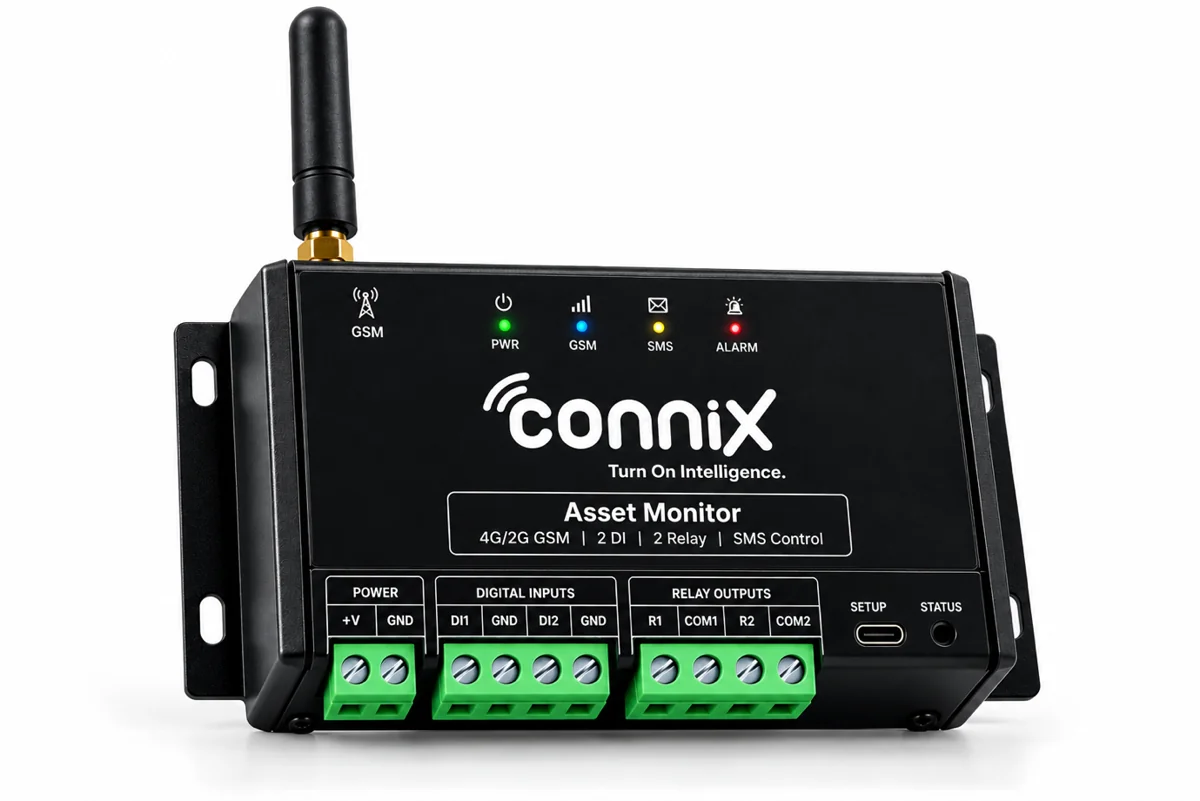
Illustrative image; the end product may differ.
Planning a similar deployment?
Tell us about your sites — we'll share what worked here.